You are given a circle represented by its radius radius and center coordinates (xCenter, yCenter). You are also given an axis-aligned rectangle represented by (x1, y1, x2, y2), where (x1, y1) is the bottom-left corner and (x2, y2) is the top-right corner of the rectangle.
Return true if the circle and rectangle overlap; otherwise, return false.
Two shapes overlap if they share at least one point. Points on the boundaries are included, so touching at a single point also counts as overlapping.
Example 1:
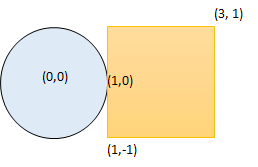
Input: radius = 1, xCenter = 0, yCenter = 0, x1 = 1, y1 = -1, x2 = 3, y2 = 1
Output: true
Explanation:
- The circle is centered at
(0, 0)with radius1, and the rectangle extends from(1, -1)to(3, 1). - The circle and rectangle touch at the point
(1, 0), which lies on the circle's boundary and the rectangle's left edge. - Since they share at least one point, they overlap. Therefore, return
true.
Example 2:
Input: radius = 1, xCenter = 1, yCenter = 1, x1 = 1, y1 = -3, x2 = 2, y2 = -1
Output: false
Explanation:
- The circle is centered at
(1, 1)with radius1, while the rectangle extends from(1, -3)to(2, -1). - The closest point on the rectangle to the circle's center is
(1, -1). The distance between these points is2, which is greater than the circle's radius of1. - Since the circle cannot reach the rectangle, they do not overlap. Therefore, return
false.
Example 3:
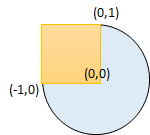
Input: radius = 1, xCenter = 0, yCenter = 0, x1 = -1, y1 = 0, x2 = 0, y2 = 1
Output: true
Explanation:
- The circle is centered at
(0, 0)with radius1, and the rectangle extends from(-1, 0)to(0, 1). - The point
(0, 0)is both the center of the circle and the bottom-right corner of the rectangle. - Since this point belongs to both shapes, they overlap. Therefore, return
true.
Constraints:
1 <= radius <= 2000-104 <= xCenter, yCenter <= 104-104 <= x1 < x2 <= 104-104 <= y1 < y2 <= 104