


Bellman Ford Algorithm | Easy 🚀
Why we need this algo? 🤖
- For a graph without any negative edge and negative cycle, We can use Dijkstra Algorithm to find the shortest path.
- But if a Graph contains negative edge and negative cycle then Dijkstra will fail and we need to Bellman ford algo for the same.
- Alog with that Bellman can help you find if the graph contains negative cycle.
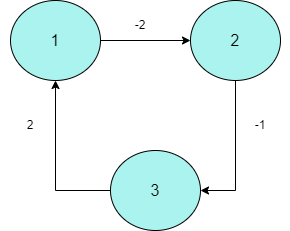
Negative cycle in a graph means any path weight in the graph might result a negative value. for eg : in the below graph path weight = -2-1+2 = -1, hence negative cycle.
Note that if you keep on moving in the cycle path weight will be decreasing again and again.
What is edge relax? 🤕
In the Graph, if you are going to v from u. then simply apply the below condition:
if(dist[u] + weight < dist[v]){
	dist[v] = dist[u] + weight;
}
dist[u] = distance already taken to reach U node
dist[v] = distance already taken to reach V node (Some else might already visited V)
weight = distance to V from U
So, relaxing an edge means updating the distance for the connected nodes. 😁
How it works?
- if the graph contains N Nodes , we need relax all the edges N-1 times
class Solution {
    static int[] bellman_ford(int V, ArrayList<ArrayList<Integer>> edges, int S) {
        //Store the distance taken to reach a node
        int[] dist = new int[V];
        Arrays.fill(dist, (int)(1e8));
        //Source will be always 0 , others will be +infinity
        dist[S]=0;
        //Relax all the edge number of nodes - 1 times
		//O(V * E)
        for(int i=0; i<V-1; i++){
            //relax edges for each iteration
            for(ArrayList<Integer> edge : edges){
                int node = edge.get(0);
                int adjNode = edge.get(1);
                int wt = edge.get(2);
                //if the distance is +infinity then no need to update distance
                if(dist[node]!=(1e8) && dist[node]+wt < dist[adjNode]){
                    dist[adjNode] = dist[node]+wt;
                }
            }
        }
        //if the graph don't contain any negative cycle, then we can't update distance Nth time
        for(ArrayList<Integer> edge : edges){
            int node = edge.get(0);
            int adjNode = edge.get(1);
            int wt = edge.get(2);
            //if the below condition pass, it means there is a cycle - becausing travelling in a negative cycle will keep on decreasing the distance😥
            if(dist[node]!=(1e8) && dist[node]+wt < dist[adjNode]){
                int[] temp = {-1};
                return temp;
            }
        }
        return dist;
    }
}
Why N-1 times ?
🤔 if we try to draw a graph with N nodes, where from source to destination it should take more than N-1 edge. it is impossible until there is a cycle. 🤦♂️

In the above We can reach 3 from 1 with 2 edges, means N-1 edges. We can introduce cycle to increase the edge. But we should avoid cycle to reach the destination.