


Machine coding rounds are the easiest to crack given you know the pattern which almost every question has,
'
Key Points:
- Machine Coding round questions are designed to be solved in 1.5 hours. So, it is programmer's duty to not over complicate it.
- All the solutions revolve around the same template.
- There will be 3-4 entity classes.
- There will be 2-3 service (or manager classes).
- You will need few helpers, like Uid generator class, Factory classes, logger class(good to have).
- And ofcourse interfaces to ensure loose coupling.
- Don't try to improve on time complexity and space complexity by thinking of optimized algorithms. You will have a seperate DSA round for that. Go with brute force and save time.
It boils down to identifying these entity classes and service classes, designing their properties and behaviors and then implementing it all.
Time Division:
- Complete the Design on paper and pen(preferably) with in 15 to 25 minutes. Design includes not only identifying entity classes, service classes and helper classes but also listing down their properties and behaviors.
- Once ready with design , quickly skim through all the API's to be implemented and mentally figure out how will your classes interact to achieve them. This shall ensure your design is complete.
- Take 1 hour to implement the design. Since, you know what exactly to implement, this should be possible given you have practiced 4 to 5 problems and have good command over your language.
- Last five minutes write 1 to 2 test cases for each of the API's asked and ensure they are running well. Don't spend time in writing too many test cases.
Tip: Generally there is a 30 mins breifing session prior to the 1.5 hours of solving time where the problem is explained and all questions are answered by the interviewer. You can start the design during this session itself. But make sure you understand the problem first. (Also, clarify things like if an Entity's attribute is unique. For instance, suppose you have a Restaurant entity, can many restaurants have same name? or can we assume the names are unique?)
Example:
Description: Implement an online food ordering system. Features:
1. This system has a tie-up with restaurants where each restaurant has a menu with all the
items & their prices. Restaurants also have a rating out of 5.
2. Each restaurant has max #orders it can process at any given time. Beyond that, it
shouldn’t be assigned any further orders until an ongoing order is completed.
3. Once an order is ACCEPTED, the restaurant can mark it as COMPLETED when the order is ready. This will free up the processing capacity of the restaurant. A restaurant can’t CANCEL an ACCEPTED order.
4. An order will be auto-assigned to a restaurant based on a selection strategy. Eg: Assign
by lowest cost or best rating.
5. An order will be auto-assigned to a restaurant only if all the items in an order can be fulfilled by a single restaurant. Else the order will not be ACCEPTED.
Requirement:
Onboard a new restaurant with a menu.
A customer should be able to place an order by giving items, respective quantities & selection strategy.
Restaurants can mark ACCEPTED orders as COMPLETED. Orders once ACCEPTED can’t be CANCELLED by a restaurant.
Order will be auto-assigned to a restaurant based on a selection strategy.
Implement at least one restaurant selection strategy.
A restaurant should be able to update its menu. For simplicity, a restaurant can't delete an item from the menu.
Note: Do not use any database or NoSQL store, use an in-memory store.
Expectation:
1. Make sure that you have working and demoable & functionally correct code.
2. Use proper abstractions, separation of concerns, proper entity modeling
3. Use appropriate design patterns wherever required.
4. The code should be modular, extensible, readable and unit-testable.
5. Proper exception handling is required.
6. Restaurant selection strategy must be pluggable
7. Concurrency handling (BONUS / Good to have)
8. Unit test cases (Bonus/ Good to have)

Assumptions:
Unique restaurant name
No need to create the user.
Sample test cases:
This is for illustration purposes only.
You can define your ways to take input.
You can use driver class or take input from console or you can write UT’s
1. Onboard Restaurants
● R1
“max_orders_that_can_be_processed_at_a_time” : 5, “Menu”: [Veg Biryani : Rs.100, Paneer Butter Masala: Rs.150],
“rating”: 4.5/5

● R2
“max_orders_that_can_be_processed_at_a_time”: 5,
menu: [Paneer Butter Masala : Rs.175, Idli : Rs.10, Dosa : Rs.50, Veg Biryani : Rs. 80],
rating: 4/5

● R3
“max_orders_that_can_be_processed_at_a_time”: 1,
menu: [Gobi Manchurian : Rs.150, Idli : Rs.15, Paneer Butter Masala : Rs.175, Dosa: Rs.30 ],
rating: 4.9/5
2. Update restaurant menu
● ADD: {Restaurant_1, add, Chicken65, Rs.250}
● UPDATE: {Restaurant_2, update, Paneer Butter Masala, Rs.150}

3. Place Order
Order1
Input: { user: Ashwin, items: [ 3*Idli, 1*Dosa ], selection: Lowest cost }
Output: Order assigned to R3

Order2.
Input: { user: Harish, items: [ 3*Idli, 1*Dosa ], selection: Lowest cost }
Output: Order assigned to R2 (Not R3 since it has reached its full capacity from Order1)
Order3:
Input: { user: Shruthi, items: [3*Veg Biryani], selection: ‘Highest rating’ }
Output: Order assigned to R1

4. Update Order Status:
R3 marks Order1 as COMPLETED Order4:
Input: { user: Harish, items: [ 3*Idli, 1*Dosa ], selection: Lowest cost }
      Output: Order assigned to R3 (since R3 has COMPLETED Order1)

Order5:
Input: {user: xyz, items: [1*Paneer Tikka, 1*Idli], selection: ‘Lowest cost}
Output: Order can’t be fulfilled (since none of the restaurants above serve Paneer Tikka)
Design:
This is how I like to do it.
-
Idenity Actors and their use cases.
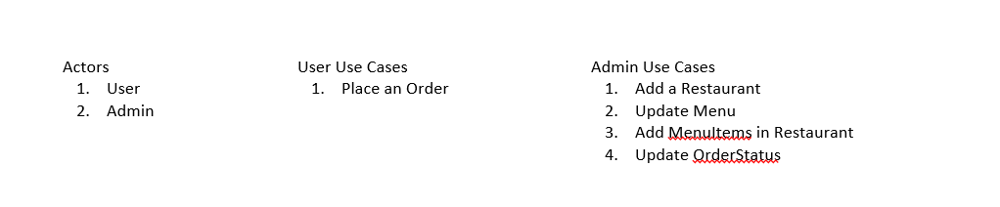
-
Go through the use cases and think of various Entities and Services involved
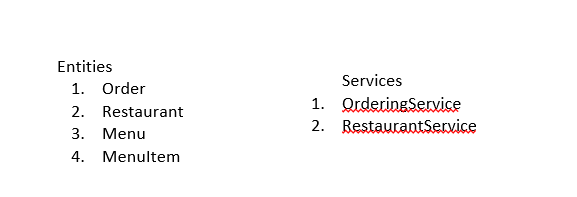
-
Design the classes (Also identify interfaces for loose coupling, I didn't mention them here)
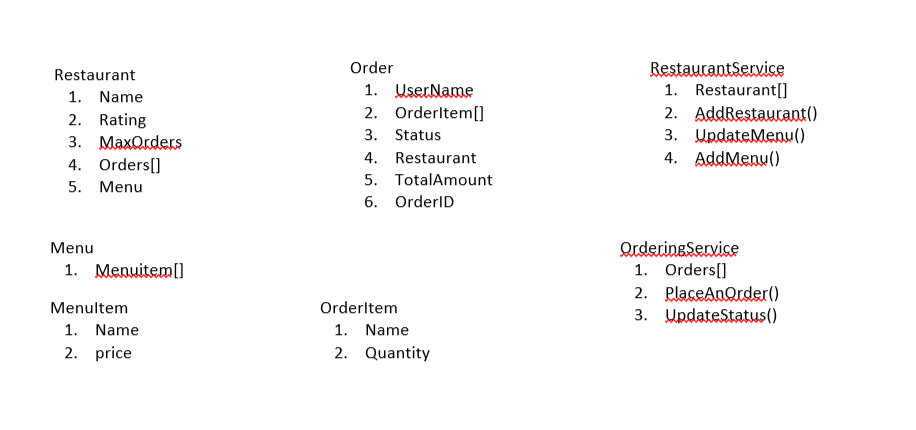
-
Implement it
https://github.com/ajayseeker/Machine-Coding-/tree/main/FoodOrderingSystem
Pro tip: Since, all questions revolve around the same template i.e. 3-4 entity classes, 2-3 Service classes, 2-3 helper classes. It is a good idea to create a project in your IDE in advance with proper folder structure :- Entities, Services, Intefaces and Helpers. You can then create classes too inside the folders in advance. After completing the design, you can just rename classes and implement code (Tada! you have saved few minutes!). Also, consider writing the logger, UidGenerator class code before hand.
(The code link shared here has the exact code I wrote in the interview within 1.5 hours (Not claiming it to be the best!). And yes I could clear the round.)
Practicing 3-5 questions should give you lots of confidence. Always time your practice attempts.
Do write your thoughts in comments.