


So After Solving DP Question for Quite a few days, I came up with some Summary that will help you through your DP Journey.
Here is my practical guide to solving DP problems.
- Think of the Recursion state: Define your dp[..][..]meaning e.g. for https://leetcode.com/problems/longest-increasing-subsequence/, dp[i] = the length of the longest increasing subsequence that ENDS on element i.
For Medium-Level there are 5Types of Forms Available:
-
- Knapsack type? {take it or not take it} -> example[Target sum, house robber 2]
-
- Ending With DP type? {best ending at this level}
-
- L-R DP type?
-
- GAME DP?
-
- Subsequence DP? [LCS, LIS, LPS]
-
Think of Recursion Transitions
-
When coming up with a recurrence relation, separately come up with a general case and base cases.
-
People usually prefer either the top-down or the bottom-up style.
-
At its core, DP problems are really graph problems. Here each dp[...][...][...] terms are nodes and edges are drawn based on recurrence relations. For your problem to have a DP solution, this graph MUST BE a DAG. This is usually what textbooks mean "optimal substructure". For me, this connection of DP to its graph representation greatly helped.
-
Once you "get" the solid understanding, then solve problems to find and internalize common patterns.
**Example For Question: ** https://leetcode.com/problems/climbing-stairs/
Problem list : List 1
Problem list : List 2
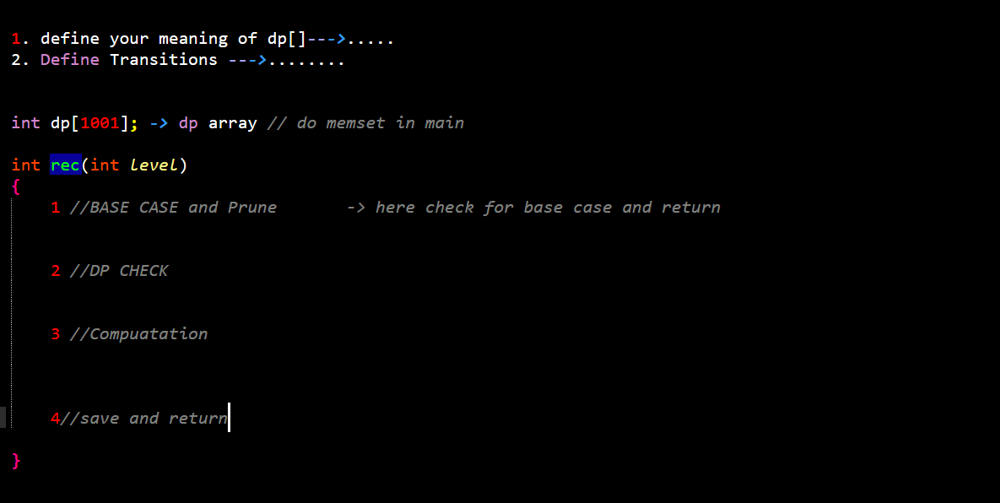
Steps to think of any DP solution
- Form states and state meaning: int rec(level)-> returns the number of ways you can reach level to n by +1 and +2 steps
- Transitions rec(level) -> rec(level+1)
-> rec(level +2)
- Base Case
- Pruning
- Dp check
- Computation
- save and return
class Solution
{
    int dp[50]; // cache/dp array
    int n; // the level you want to reach
    int rec(
        int level) // rec(level)-> returns the possible ways you can reach n with +1 and +2 steps
    {
        // base case
        if (level == n)
            return 1;

        // cache check
        if (dp[level] != -1)
            return dp[level];

        // computation
        int ans = 0;
        if (level + 1 <= n)
        {
            ans += rec(level + 1);
        }
        if (level + 2 <= n)
        {
            ans += rec(level + 2);
        }

        // cache and return
        return dp[level] = ans;
    }

public:
    int climbStairs(int na)
    {
        n = na;
        memset(dp, -1, sizeof(dp)); // resetting dp array to -1
        return rec(0); // returning the value from level =0 to n with +1 and +2 steps
    }
};
One should have a mind make up of Recursion like this
DO GIVE STARS ⭐ ⭐ ⭐ ⭐ ⭐ ⭐ ⭐ ⭐ ⭐ ⭐ ⭐ ⭐ ⭐ ⭐ ⭐ ⭐ ⭐ ⭐ ⭐ ⭐ ⭐