Where leetcode still matters in 2026: I analyzed 74 recent engineering interviews across 8 companies

I kept seeing two opposite takes:
- “Top-company interviews are still mostly LeetCode.”
- “LeetCode is becoming less useful because companies now test practical engineering.”
After structuring 229 candidate experiences across 41 companies, my takeaway is that both statements are true — depending heavily on the company.
For this post, I filtered the data to 74 engineering and technical interview experiences from 2024–2026 across:
- Meta
- Amazon
- Microsoft
- OpenAI
- Anthropic
- Stripe
TL;DR
- Google, LinkedIn and Microsoft still showed the clearest algorithm/DSA signal.
- Meta looked increasingly hybrid: traditional DSA, system design, behavioural evaluation and newer AI-assisted coding rounds.
- Amazon still used DSA, but design depth and Leadership Principle discussions appeared just as consistently.
- Stripe was the clearest practical-coding outlier: multi-part implementation, integrations, debugging, validation and business rules.
- OpenAI and Anthropic leaned more toward implementation and systems depth than short puzzle solving.
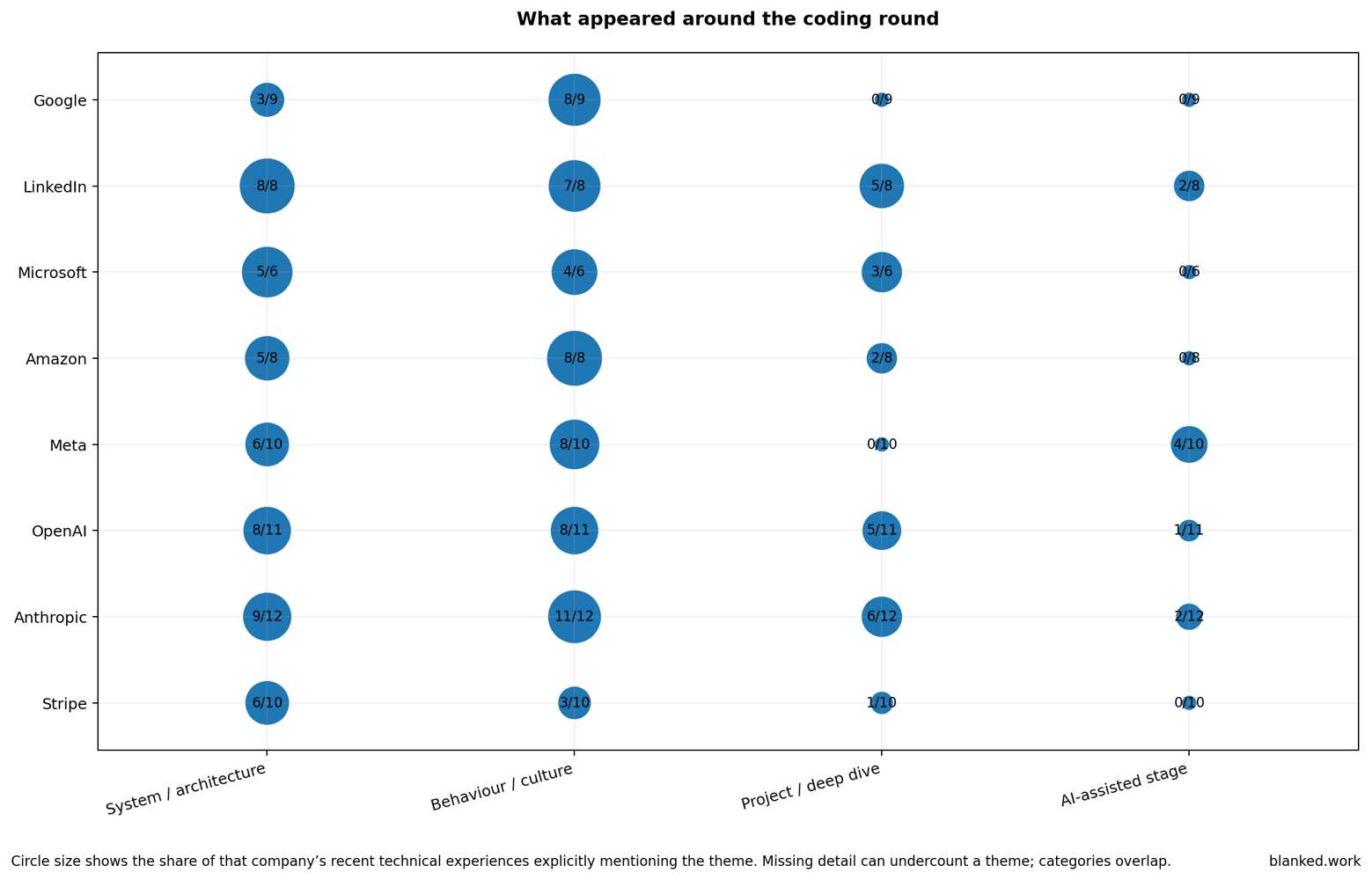
- Anthropic also had the strongest explicit values, safety and judgement signal in this dataset.
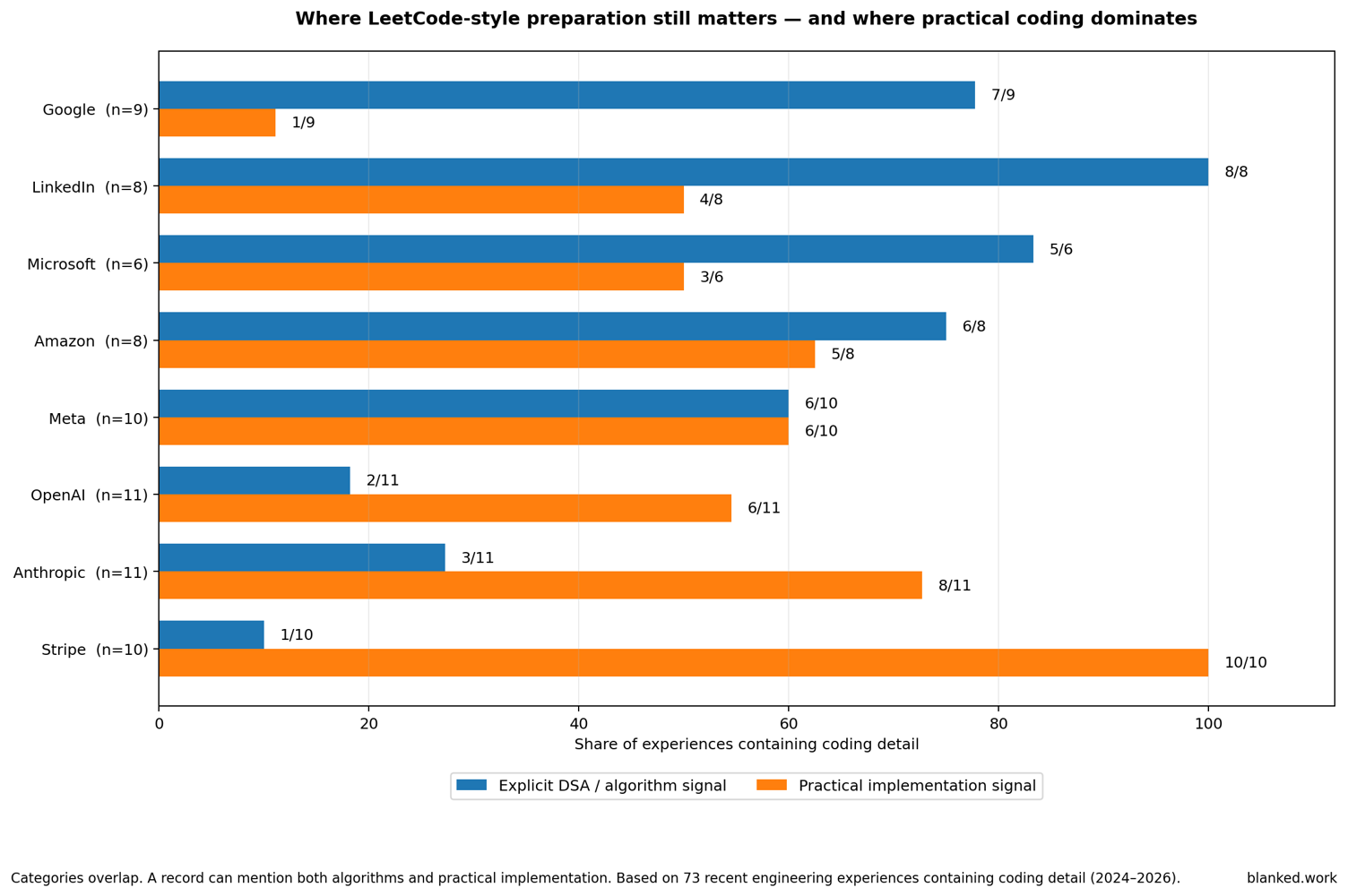
The two bars are not mutually exclusive. An interview experience can contain both a DSA problem and a practical implementation task.
The company-by-company preparation map
| Company | Strongest preparation focus | What repeatedly appeared |
|---|---|---|
| DSA plus clear verbal reasoning | Graphs, DP, heaps, custom problems, follow-ups and Googliness | |
| DSA, system design and engineering excellence | Multiple coding rounds, concurrency, large-scale design, project and leadership depth | |
| Microsoft | DSA plus LLD/OOP | Trees and graphs, concurrency, low-level design, system design and project discussion |
| Amazon | DSA, system design and technically deep LP stories | Coding, HLD/LLD, ownership, trade-offs and repeated Leadership Principle follow-ups |
| Meta | DSA speed, product design and AI-output verification | Two-problem coding rounds, system design, behavioural pressure and newer AI-assisted rounds |
| OpenAI | Practical implementation, refactoring and end-to-end design | Building working systems, unfamiliar code, reliability, project deep dives and product judgement |
| Anthropic | Practical coding, systems depth and values/safety judgement | Debugging, infrastructure, AI-system trade-offs, culture, ethics and constructive disagreement |
| Stripe | Multi-part practical coding and integration work | APIs, parsing, validation, debugging, tests, reconciliation and business rules |
1. LeetCode is still the correct base for some companies
Among the recent experiences containing coding detail:
- LinkedIn: DSA or algorithmic work appeared in 8 of 8
- Microsoft: 5 of 6
- Google: 7 of 9
- Amazon: 6 of 8
- Meta: 6 of 10
This does not mean grinding tagged questions is sufficient.
Across these companies, candidates repeatedly described being evaluated on:
- explaining the approach before coding;
- handling follow-up constraints;
- producing complete code within time;
- testing edge cases;
- adapting after hints;
- communicating trade-offs clearly.
For Google in particular, several experiences described custom or unfamiliar problems where structured clarification mattered as much as recognising a pattern.
2. Stripe is the biggest mismatch for a pure LeetCode preparation plan
Every one of the 10 recent Stripe technical experiences in this cohort explicitly contained practical implementation work.
The recurring themes were:
- extending an API or existing system;
- parsing and validating data;
- implementing several requirements sequentially;
- finding bugs in an unfamiliar codebase;
- integration work using documentation or SDKs;
- modelling payment, invoice or reconciliation rules;
- writing maintainable code and tests under time pressure.
Only 1 of 10 explicitly resembled a conventional DSA-heavy exercise.
If I had a Stripe interview, I would spend less time trying to memorise another 100 patterns and more time practising:
- reading a long requirement carefully;
- implementing it in clean stages;
- debugging existing code;
- handling malformed input and edge cases;
- explaining business rules and correctness.
3. OpenAI and Anthropic reward a different kind of technical depth
OpenAI
Within the 11 recent technical experiences:
- practical implementation appeared in 6 of 11;
- system or architecture design appeared in 8 of 11;
- project or technical deep dives appeared in 5 of 11.
Reported tasks included broader implementation, refactoring, APIs, reliability, distributed systems and end-to-end product design.
The recurring preparation lesson was:
Be able to build and reason about a working system, not only derive an algorithm.
Anthropic
Within the 12 recent technical experiences:
- practical implementation appeared in 8 of 12;
- system or architecture design appeared in 9 of 12;
- behavioural, culture or values evaluation appeared in 11 of 12;
- project or technical deep dives appeared in 6 of 12.
The technical side often involved debugging, infrastructure, operational trade-offs and AI-system design.
The non-technical side was unusually substantive: mission, safety, ethical disagreement, judgement under ambiguity and willingness to challenge a decision constructively.
4. Meta’s AI-assisted rounds are additive — not a replacement for DSA
In the Meta cohort:
- DSA appeared in 6 of 10 experiences;
- practical implementation appeared in 6 of 10;
- system design appeared in 6 of 10;
- an explicitly AI-assisted stage appeared in 4 of 10.
The important point is that the newer AI-enabled coding work did not remove conventional coding or design.
Candidates described needing to:
- inspect generated suggestions rather than trust them blindly;
- debug and extend imperfect code;
- explain why a suggestion was accepted or rejected;
- preserve standard coding speed and DSA fundamentals;
- still complete product/system design and behavioural rounds.
So “AI is allowed in the interview” does not necessarily mean the interview becomes easier. It introduces another skill: verification.
5. Amazon is the clearest warning not to neglect the non-coding rounds
In the eight recent Amazon engineering experiences in this cohort:
- DSA appeared in 6 of 8;
- explicit system or architecture design appeared in 5 of 8;
- Leadership Principle / behavioural evaluation appeared in 8 of 8.
Several candidates reported strong coding performance but rejection or downlevel outcomes after weaker design or broader evaluation.
The useful preparation lesson is not “memorise STAR stories.”
It is:
Prepare behavioural examples with enough technical depth to survive several follow-up questions about your decisions, trade-offs, ownership and actual contribution.
What I would change in my preparation
Google / LinkedIn / Microsoft
Keep DSA as the foundation, but practise it in interview conditions:
- explain before coding;
- ask clarifying questions;
- finish the implementation;
- test edge cases;
- handle a follow-up;
- prepare behavioural and design depth appropriate to level.
Meta / Amazon
Do not separate “coding prep” from the rest of the loop.
Prepare:
- timed DSA;
- system or product design;
- one technically deep project;
- conflict and ownership stories;
- AI-output verification where relevant.
OpenAI / Anthropic
Practise larger, messier engineering work:
- implement a feature from a long prompt;
- refactor unfamiliar code without breaking tests;
- debug a pipeline or service;
- reason through reliability and operational constraints;
- present one project deeply;
- defend decisions under ambiguity.
Stripe
Practise the work around the algorithm:
- parse;
- validate;
- integrate;
- debug;
- model business rules;
- write tests;
- complete incremental requirements cleanly.
Methodology and limitations
- The full dataset contains 229 candidate experiences across 41 companies.
- This post uses 74 engineering/technical experiences dated 2024–2026 from the eight companies above.
- A theme was counted only when the structured experience explicitly mentioned it.
- Categories overlap.
- Missing detail can undercount a theme; absence from the chart does not prove a company never tests it.
- These are candidate experiences, not official fixed processes.
- The outcome mix is self-selected and should not be interpreted as an acceptance rate.
I put the employer-level process breakdowns and candidate findings into a searchable version here:
https://www.blanked.work/employers
I would genuinely like corrections from people who interviewed recently:
- Which company does this map get most right?
- Where is it wrong or already outdated?
- Which company should I break down next?
The goal of blanked is to have a total transparent hiring process for each employer which is crowd sourced and free so you can see what you are getting yourself into, its totally anon and free.