


The Tower of Hanoi
The Tower of Hanoi problem involves moving a stack of disks from one peg to another, following these rules:
- Only one disk can be moved at a time.
- A disk can only be placed on top of a larger disk or an empty peg.
- All disks start on one peg and need to be moved to another peg using an intermediate peg.
For 𝑛=3 disks, the goal is to move all disks from the source peg (A) to the destination peg (C) using the helper peg (B).
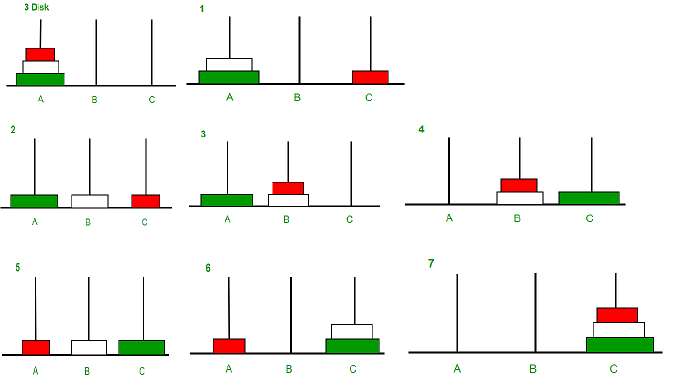
Explanation
Problem: Move n disks from peg A (source) to peg C (destination) using peg B (helper).
Rules:
- Move one disk at a time.
- A larger disk cannot be placed on a smaller disk.
Program Breakdown
Main Method:
- Initializes the number of disks (n = 3).
- Calls towerOfHanoi to solve the puzzle.
towerOfHanoi Method:
Base Case: If there is only 1 disk, move it directly from the source peg to the destination peg.
Recursive Steps:
- Move n−1 disks from the source peg to the helper peg.
- Move the nth disk from the source peg to the destination peg.
- Move the n−1 disks from the helper peg to the destination peg.
Code (java)
public class Solution {
    public static void towerOfHanoi(int n, String src, String helper, String dest) {
        if (n == 1) { // Base case
            System.out.println("transfer disk " + n + " from " + src + " to " + dest);
            return;
        }
        towerOfHanoi(n-1, src, dest, helper); // Step 1
        System.out.println("transfer disk " + n + " from " + src + " to " + dest); // Step 2
        towerOfHanoi(n-1, helper, src, dest); // Step 3
    }

    public static void main(String[] args) {
        int n = 3; // Number of disks
        towerOfHanoi(n, "A", "B", "C"); // Solve the problem
    }
}
Output
transfer disk 1 from A to C
transfer disk 2 from A to B
transfer disk 1 from C to B
transfer disk 3 from A to C
transfer disk 1 from B to A
transfer disk 2 from B to C
transfer disk 1 from A to C
Conclusion
- The Tower of Hanoi program uses recursion to move disks between pegs according to specific rules. It efficiently breaks down the problem into smaller steps, ensuring all disks are correctly moved from the source peg to the destination peg. This demonstrates the power and simplicity of recursive solutions.
Comments (7)