


Design a system in which user is subscribing to some stocks from list of stocks. User will set some rules on basis of which if the rules are broken we have to sent notificaiton to user. For eg: let say user have subscribed to uber stock and set rule that if stock price goes above 60$ send me notification.
FR:
- Different rules that can be set by users are opening price, current price, moving average, etc. User can choose comparators like less than, equal to, greater than a particular number.
- User should get the notification within a minute.
NFR:
- System should be able to scan and check more than 1 million rules set by users and send notification if any rule is satisfied.
Edit: Attaching Design Diagram here.
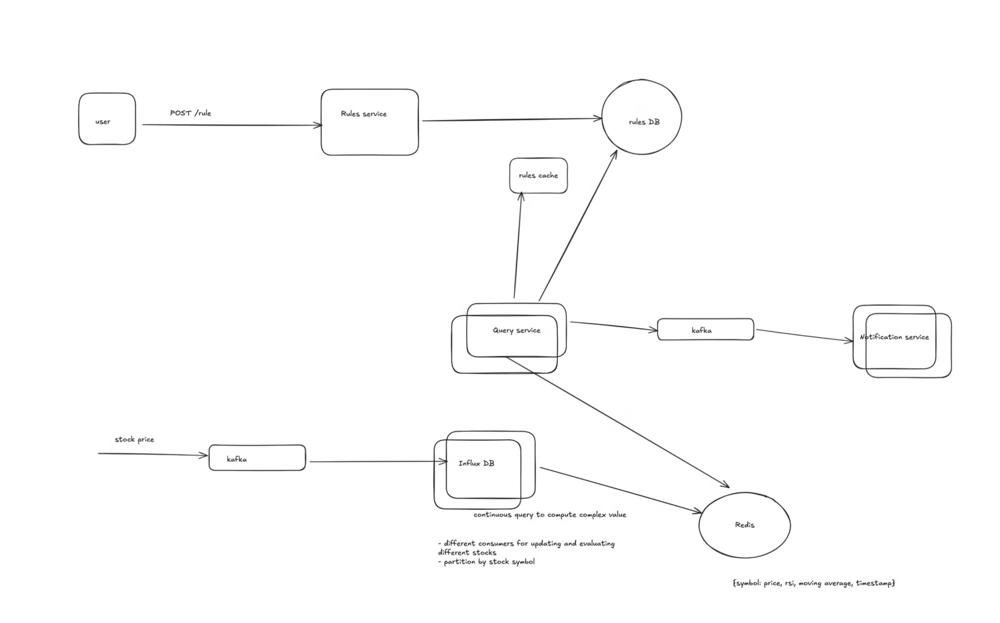
Core entities
- stock price
- user_rule
- notification
APIs/interfaces
-
POST /rule
{
symbol: AAPL
metric type: rsi, price
value: 150, rule_type: above
} -
POST /notification
{
user_id
rule_id
} -
A kafka stream to ingest stock price updates.
DB choices:
- for stock prices
a. we can use time series Database, like influx DB. why?
provides high write throughput
allows efficient time series related queries. - can easily handle large volume of updates. - rules/user_subscriptions:
- use relational database like MySQL.
DB design
- stock price
- symbol
- price
- timestamp
- rsi(precomputed using continuous queries)
- rule
- rule_id
- metric type
- value
- rule_type
- subscribers
There can millions of user rules which need to be evaluated when a new stock prices comes up. How can we make this fast ?
- Partition Rules by Stock Symbol: Since each rule is linked to a specific stock symbol, you can partition or shard the user rule table by stock symbol.
- Use an in-memory cache like Redis to store user rules for fast lookups.
- Store rules in sorted data structures like Redis Sorted Sets or B-trees. These can allow for efficient range queries on thresholds.
- If users frequently set similar rules (e.g., "above 50"), aggregate these rules.
What if rules are complex for eg- average price of stock in last 7 days, moving average, rsi ? How will we store and query them with low latency ?
- Time series databases like InfluxDB and TimescaleDB are specifically designed for handling time-based data, making them ideal for pre-computing derived metrics like moving averages and RSI.
- Store derived metrics in the same time series database:
- Use Redis for caching: Cache the most recent precomputed metrics (e.g., 7-day moving average, RSI) for quick access during rule evaluation.
how will we handle the scenario if a rule set on a stock symbol keeps becoming true and then false and then true as stock price fluctuate ?
- Cooldown or Debouncing Period
- Introduce a buffer zone around the threshold condition to avoid triggering notifications for minor price changes.
- Limit the number of notifications sent within a specific time window for a single rule.
- The system only evaluates the rule again once the price falls below the threshold, and no further notifications are sent until the rule switches from false to true again.