


Users rely on rating when they want to decide what content or product have higher quality. By it’s nature, user rating is quantitative information; that is why it’s recommended to supplement it with qualitative data (user reviews).
User rating and reviews become a crowd’s wisdom, guiding users in what is good and bad.
Rating system works well when you have a large user base — the comparison between items becomes meaningful only when you have a significant number of votes/reviews. The small user base is likely won’t be able to provide enough data to create a meaningful picture.
Essential properties of rating system
Simple
It should be easy for users to leave their opinion on a particular item. Use a simple rating system such as the one mentioned below:
- Binary rating system (Like/Dislike). This rating system is known as all or nothing, and it works best for content such as articles, music, or videos.
- 1–5 stars rating. This rating system relies on 1–5 stars rating scale, where one-star signals ‘terrible’ while five stars signals an’ excellent’ experience/product. This rating system is commonly used in eCommerce.
- 1–10 stars rating. This rating system relies on 1–10 stars rating scale. It allows users to provide a more specific rating of a product/service.
When a user rates an item, the system should inform users that the rating has been recorded.
-
Add ‘rate product’ step into a post-purchase experience
For eCommerce websites, it’s recommended to trigger requests to rate a product after the user receives the product. When a person uses a product for a while, they can provide more valuable feedback. -
Prompt users to upload photos
A picture is worth a thousand words. By allowing users to upload photos, you make user reviews more descriptive — it will be much easier for other people to understand what the reviewer means. Plus, photos add credibility and authenticity. -
Provide specific criteria for evaluation
When you ask users to provide ratings and reviews, you can refer to some specific criteria for evaluation. It will help you collect more detailed feedback from your users.
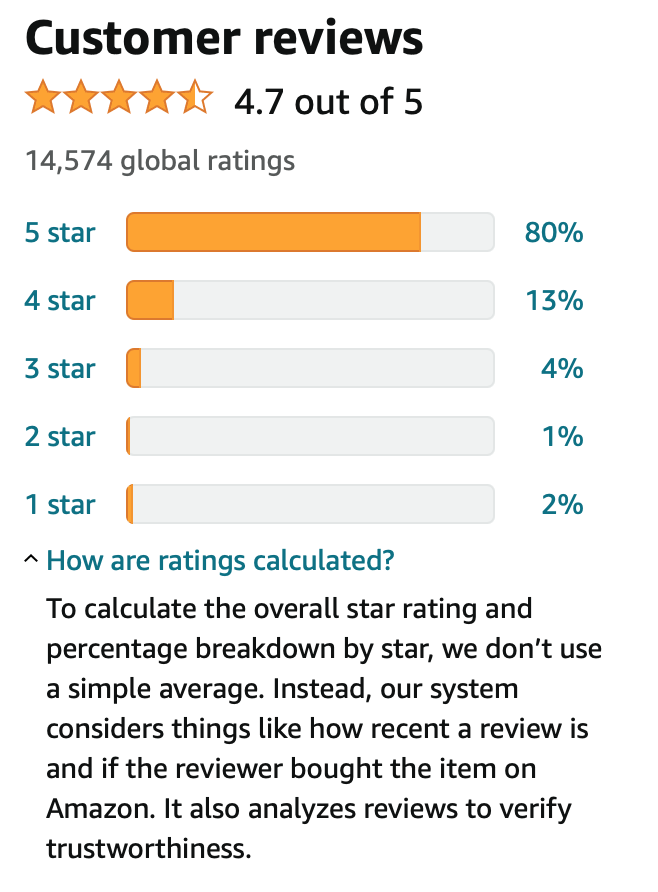
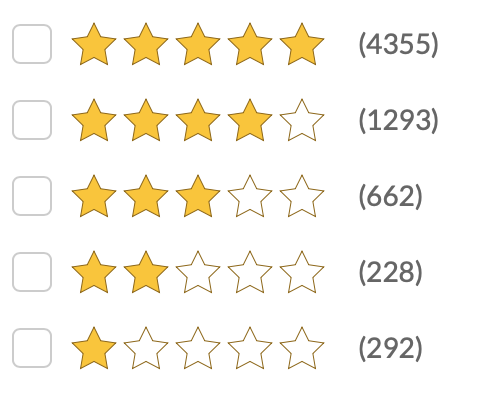
Users expect rating distribution summary to be clickable. That’s why the ratings distribution summary should act as ‘star’ filters.
Highlight ‘Most helpful positive’ and ‘Most helpful critical’ reviews
When users visit the reviews section, many of them will seek out the most negative reviews to learn what the product’s shortcomings are. When you provide this information up front, you save users time.

Introduce ‘vote to promote’ functionality to allow users to prioritize the most helpful reviews. Users can thumb up reviews that they find valuable.

Let users sort reviews by time (Most Recent) and by value (Most Helpful).