

Part 1: OOPs Fundamental Topics: Asked in recent interviews

OOPs in C++
The main aim of OOP is to bind together the data and the functions that operate on them so that no other part of the code can access this data except that function.
Characteristics of an Object Oriented Programming language

Class
It is a user-defined data type, which holds its own data members and member functions, which can be accessed and used by creating an instance of that class. A class is like a blueprint for an object.
class person {
    char name[50];
    int id;
	public:
	void getDetails() {}
}
The only difference between a structure and a class is that structure members have public access by default and class members have private access by default.
Static Member functions in C++
A function is made static by using static keyword with function name. These functions work for the class as whole rather than for a particular object of a class.
class X
{
    public:
    static void f()
    {
        // statement
    }
};

int main()
{
    X::f();   // calling member function directly with class name
}
Const Member functions in C++
When used with member function, such member functions can never modify the object or its related data members.
// basic syntax of const Member Function

void fun() const
{
    // statement
}
Object
An Object is an identifiable entity with some characteristics and behaviour. An Object is an instance of a Class. When a class is defined, no memory is allocated but when it is instantiated (i.e. an object is created) memory is allocated.
person p1;Each object contains data and code to manipulate the data. Objects can interact without having to know details of each other’s data or code.
Encapsulation
Encapsulation is defined as wrapping up of data and information under a single unit.
In Object-Oriented Programming, Encapsulation is defined as binding together the data and the functions that manipulate them.
Encapsulation also leads to data abstraction or hiding.
Abstraction
Abstraction means displaying only essential information and hiding the details.
Data abstraction refers to providing only essential information about the data to the outside world, hiding the background details or implementation.
- Abstraction using Classes
- Abstraction in Header files
Inheritance
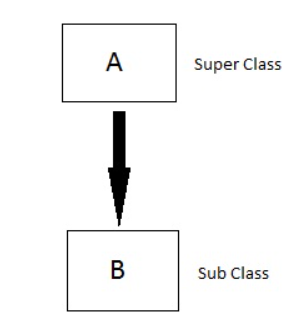
The capability of a class to derive properties and characteristics from another class is called Inheritance.
- Sub Class: The class that inherits properties from another class is called Sub class or Derived Class.
- Super Class: The class whose properties are inherited by sub class is called Base Class or Super class.
- Re-usability: Inheritance supports the concept of “re-usability”, i.e. when we want to create a new class and there is already a class that includes some of the code that we want, we can derive our new class from the existing class. By doing this, we are reusing the fields and methods of the existing class.
Basic Syntax of Inheritance
class Subclass_name : access_mode Superclass_namePublic Inheritance
This is the most used inheritance mode. In this the protected member of super class becomes protected members of sub class and public becomes public.
class Subclass : public SuperclassPrivate Inheritance
In private mode, the protected and public members of super class become private members of derived class.
class Subclass : Superclass // By default its private inheritanceProtected Inheritance
In protected mode, the public and protected members of Super class becomes protected members of Sub class.
class subclass : protected SuperclassTypes of Inheritance in C++
In C++, we have 5 different types of Inheritance. Namely,
-
Single Inheritance:
-
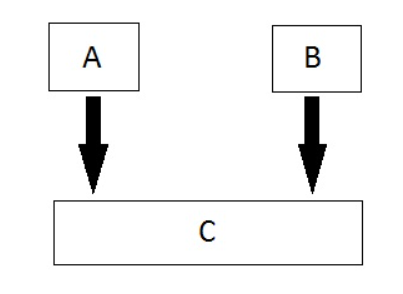
Multiple Inheritance:
-
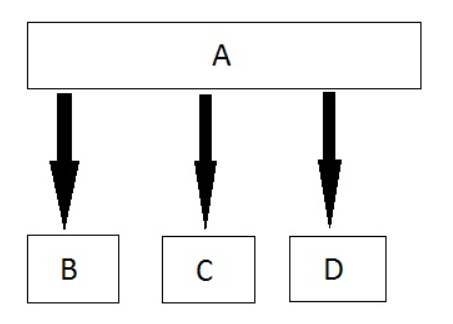
Hierarchical Inheritance:
-
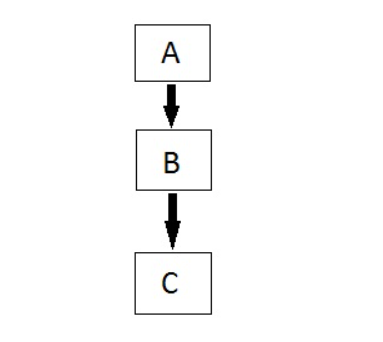
Multilevel Inheritance:
-
Hybrid Inheritance (also known as Virtual Inheritance):

Points to Remember
-
Whether derived class's default constructor is called or parameterised is called, base class's default constructor is always called inside them.
-
To call base class's parameterised constructor inside derived class's parameterised constructor, we must mention it explicitly while declaring derived class's parameterised constructor.
class Base { int x; public: // parameterized constructor Base(int i) { x = i; cout << "Base Parameterized Constructor\n"; } }; class Derived : public Base { int y; public: // parameterized constructor Derived(int j):Base(j) { y = j; cout << "Derived Parameterized Constructor\n"; } }; -
All the Base class's constructors are called inside derived class's constructor, in the same order in which they are inherited.
class A : public B, public C ;
Ambiguity Resolution in Inheritance
Ambiguity can be occurred in using the multiple inheritance when a function with the same name occurs in more than one base class. The issue can be resolved by using the scope resolution operator with the function.
class A {
    public:
    void func() {
        cout << " I am in class A" << endl;
    }
};

class B {
    public:
    void func() {
        cout << " I am in class B" << endl;
    }
};

class C: public A, public B {


};

int main() {
    C obj;
    obj.A::func();         // Calling function func() in class A
    obj.B::func();         // Calling function func() in class B
    return 0;
}
Hybrid Inheritance and Virtual Class in C++
In Multiple Inheritance, the derived class inherits from more than one base class. Hence, in Multiple Inheritance there are a lot chances of ambiguity. This is related to the famous dimond problem. The Diamond Problem occurs when a child class inherits from two parent classes who both share a common grandparent class. This is illustrated in the diagram below:

class A
{
    void show();
};

class B:public A
{
    // class definition
};

class C:public A
{
    // class defintion
};

class D:public B, public C
{
    // class definition
};

int main()
{
    D obj;
    obj.show();
}
In this case both class B and C inherits function show() from class A. Hence class D has two inherited copies of function show(). In main() function when we call function show(), then ambiguity arises, because compiler doesn't know which show() function to call. Hence we use Virtual keyword while inheriting class.
class B : virtual public A
{
    // class definition
};

class C : virtual public A
{
    // class definition
};

class D : public B, public C
{
    // class definition
};
Now by adding virtual keyword, we tell compiler to call any one out of the two show() functions.
Polymorphism
The word polymorphism means having many forms.
There are two types of polymorphism in C++:
-
Compile Time Polymorphism:
The overloaded functions are invoked by matching the type and number of arguments. This information is available at the compile time and, therefore, compiler selects the appropriate function at the compile time. It is achieved by
function overloading and operator overloadingwhich is also known as static binding or early binding. -
Run-time Polymorphism:
Run time polymorphism is achieved when the object's method is invoked at the run time instead of compile time. It is achieved bymethod overridingwhich is also known as dynamic binding or late binding

C++ supports operator overloading and function overloading.
- Operator Overloading: The process of making an operator to exhibit different behaviours in different instances is known as operator overloading.
class Complex {
private:
    int real, imag;

public:
    Complex(int r = 0, int i = 0)
    {
        real = r;
        imag = i;
    }

    // This is automatically called when '+' is used with between two Complex objects
    // This is also known as "operator function". The name of an operator function is always the operator keyword followed
    // by the symbol of the operator and operator functions are called when the corresponding operator is used.
    Complex operator+(Complex const& obj)
    {
        Complex res;
        res.real = real + obj.real;
        res.imag = imag + obj.imag;
        return res;
    }
    void print() { cout << real << " + i" << imag << '\n'; }
};

int main()
{
    Complex c1(10, 5), c2(2, 4);
    Complex c3 = c1 + c2;
    c3.print();
}Output: 12 + i9- Function Overloading: Function overloading is using a single function name to perform different types of tasks.
void add(int a, int b)
{
  cout << "sum = " << (a + b);
}

void add(int a, int b, int c)
{
    cout << endl << "sum = " << (a + b + c);
}

// Driver code
int main()
{
    add(10, 2);
    add(5, 6, 4);

    return 0;
}Output:
sum = 12
sum = 15Polymorphism is extensively used in implementing inheritance.
| Compile time polymorphism | Run time polymorphism |
|---|---|
| The function to be invoked is known at the compile time. | The function to be invoked is known at the run time. |
| It is also known as overloading, early binding and static binding. | It is also known as overriding, Dynamic binding and late binding. |
| Overloading is a compile time polymorphism where more than one method is having the same name but with the different number of parameters or the type of the parameters. | Overriding is a run time polymorphism where more than one method is having the same name, number of parameters and the type of the parameters. |
| It is achieved by function overloading and operator overloading. | It is achieved by virtual functions and pointers. |
| It provides fast execution as it is known at the compile time. | It provides slow execution as it is known at the run time. |
| It is less flexible as mainly all the things execute at the compile time. | It is more flexible as all the things execute at the run time. |