


Position: L3
Location: MTV
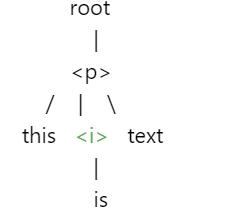
Given a DOM as a tree e.g <p> this <i> is </i> text</p> and a text (e.g. istext). Return the nodes that make up the given text.
So the tree would look like:
public List<Node> getNodes(Node root, String searchText) {
	// your code goes here
}
My Solution using Java
class Node {
	String text;
	List<Node> children
}

class Word {
	int start;
	int end;
}
I recursed through the nodes and created a string using the stringbuilder. I then used a hashmap to store the start and end of the given text in a HashMap. Then I used a sliding window to match the searchText to the stringbuilder. If there was a match then I did a 2 pointer approach starting from the beginning of the matched string and check in my HashMap for a word using start and end and added it to the List
public List<Node> getNodes(Node root, String searchText) {

	StringBuilder sb = new StringBuilder();
	HashSet<Word> map = new HashMap<>();
	buildString(root, sb, map);

	// at this point sb ="thisistext"
	// map = {{0,5},{5,7},{7,11}} -> forgive indice mismatch but the general idea is correct

	// do sliding window to match searchText against sb
	int i = 0;
	for (i; i < sb.length() - searchText.length(); i++) {
		if (sb.substring(i, searchText.length()).equals(searchText)) {
			break;
		}
	}
	int start = i;
	int end = i + 1;

	List<Node> res = new ArrayList<>();
	while (start <= end && end < searchText.length()) {
		Word curr = new Word(start, end);
		if (map.contains(curr) {
			res.add(map.get(curr));
			start = end;
			continue;
		}
		end++;
	}

	return res;
}

public void buildString(Node root, StringBuilder sb, HashSet<Word> map) {
	if (root == null) return;

	if (root.text != null) {
		map.put(new Word(sb.length(), sb.length() + root.text.length());
		sb.append(root.text);
	}
	for (Node child : root.children()) {
		buildString(child, sb, map);
	}
}
I said that the alg would run in O(n) where n is number of nodes and the string matching/two pointer approach would run in O(m). They seemed happy with this solution.