


Position: Software Development Internship 2019
Location: Pune, India
Question:
Consider the sea to be a cartesian plane. There are ships at different places in the sea. Given two points, which are the top right and bottom left corners of a rectangle, find the number of ships present in between the two points (more specifically, ships present inside the rectangle formed by these two points).
- You have a function
hasShips(A: Point, B: Point) -> boolwhich takes two Points as arguments and returns a boolean. If there are ships in between the two points, it returns true, else false. - If you want to check whether a ship is present at a point, say
A(2, 2), you can pass the same point twice into the function above as so:hasShips(A, A)which returns true if there's a ship at point A, and aliter.
The Point class looks like:
class Point():
	def __init__(self, x, y):
		self.x = x
		self.y = y
NOTE: The interviewer specifically asked to start checking from bottom to top.
Naive solution that I first came up with:
Let's say the points are bottom_left & top_right respectively.
def countShips(bottom_left: Point, top_right: Point) -> int:
	shipCount = 0
	for i in range(bottom_left.y, top_right.y+1):
		for j in range(bottom_right.x, top_right.x+1):
			pointToCheck = Point(i, j)
			if (hasShips(pointToCheck, pointToCheck):
				shipCount += 1
	return shipCount

# Print statement below was already given
print(countShips(bottom_left, top_right)
Time complexity would be O(m*n) where m & n are the dimensions of the rectangle formed by the given coordinates. In general, the code runs in O(n^2), which is a red flag!
Divide & Conquer Approach
NOTE: Not sure about if the solution is, but this is what I answered to the interviewer.
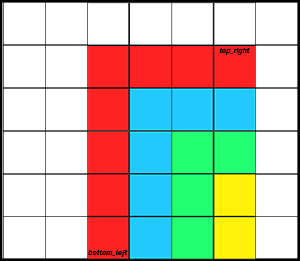
We check row and column wise and go on decreasing the checking size. If there are no ships in a row and column, we need not iterate through each element there. In the picture above, the red part is iteration 1, blue is iteration 2 and so on. If any row or column doesn't contain a ship, we would ignore it, but if it does, we iterate through each element in the row and column and count the ships.