


I recently appeared for Juspay OA for SDE-1. There were three questions to be solved, I was only able to solve this one. I am posting the question along with the test case and my solution
Round 1: It was an online round hosted of Juspay on Talscale. It consisted of 3 coding question. The coding question goes like this:
Problem Description :- Nearest Meeting Cell
You are given a maze with N cells. Each cell may have multiple entry points but not more than one exit (i.e. entry/exit points are unidirectional doors like valves). The cells are named with an integer from 0 to N-1.
You are given an array Edge[] of N integers, where Edge[i] contains the cell number that can be reached from of cell i in one step. Edge[i] is -1 if the ith cell doesn’t have an exit.
The task is to find :- Nearest meeting cell : Given any two cells - C1, C2, find the closest cell Cm that can be reached from both C1 and C2.
Note:- The cells are named with an integer value from 0 to N-1. If there is no node pointing to the ith node then weight of the ith node is zero.
INPUT FORMAT :-
- The first line contains the number of cells N.
- The second line has a list of N values of the edge[ ] array, where edge[i] conatins the cell number that can be reached from cell 'i' in one step. edge[i] is -1 if the ith doesn't have an exit.
- Third line for each testcase contains two cell numbers whose nearest meeting cell needs to be found. (return -1 if there is no meeting cell from tw.
OUTPUT FORMAT :
1.Output a single line that denotes the nearest meeting cell (NMC).
Sample Input :
23
4 4 1 4 13 8 8 8 0 8 14 9 15 11 -1 10 15 22 22 22 22 22 21
9 2
Sample Output :
4
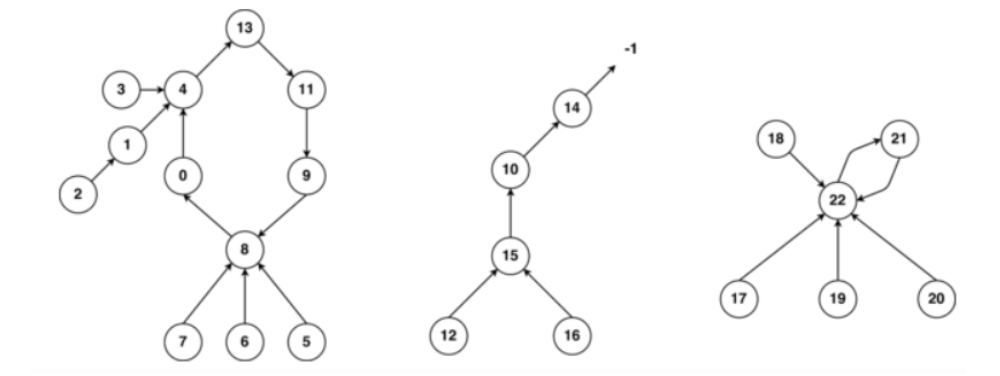
Working Solution :-
int leastCommonDescendent(int nodes[], int N, int node1, int node2){
  int *visited = new int [N];
  int cnt1 = 0; //used for counting length of path from node1 to node2
  int cnt2 = 0; //used for counting length of path from node2 to node1
  int mark = node1; //storing as a marker needed later for detecting end of search

  if(node1 == node2) return node2;
  for(int i = 0; i < N; i++){
    visited[i] = 0;
  }

  while((nodes[node1] != node1) && (nodes[node1] != -1) && (visited[node1] == 0) && (node1 != node2)){
    visited[node1]++;
    node1 = nodes[node1];
    cnt1++;
  }

  visited[node1]++; //so that first node in cycle has count 2
                    //if find a node in 2nd iteration that has count 2
                    //such that when node1 == node2 it means we are in the same subgraph
                    //elsif node1 != node2 we are in different sub graphs

  while((nodes[node2] != node2) && (nodes[node2] != -1) && (visited[node2] != 2) && (node1 != node2)){
    visited[node2]++;
    node2 = nodes[node2];
    cnt2++;
  }
  //In below case the nodes are in different disjoint subgraphs
  //and both subgraphs have loops so node1 can never be equal to node2
  //cout << visited[node1] << visited[node2] << endl;
  if(node1 != node2) return -1;
    //In below case both nodes are in different disjoint subgraphs
    //but there is no loop in 1st one(containing node1)
    //and 2nd one has a loop
  if ((nodes[node1] == -1) && (visited[node2] == 1)) return -1;
    //In below case both nodes are in different disjoint subgraphs
    //but 1st one has a loop and second one doesn't
  if(nodes[node2] == -1) return -1;
    //In below case both nodes are in same subgraph so we
    //need to check the length of two alternate paths
  if(cnt1 > cnt2)
    return node2;
  else
    return mark;
}
Other Two Can be find here :- Maximum Weight Node , Largest Sum Cycle
Kindly upvote, if you found this helpful.