


Given a list of employees in the format <"EmployeeID", "ManagerID", "City", "Phone number">
eg String[][] emps = new String[][] {
			{"e1", "e1", "NY", "phone-1"},
			{"e2", "e1", "NY", "phone-2"},
			{"e3", "e1", "NY", "phone-3"},
			{"e4", "e2", "SF", "phone-4"},
			{"e5", "e2", "NY", "phone-5"},
			{"e6", "e3", "NY", "phone-6"},
			{"e7", "e3", "NY", "phone-7"},
			{"e8", "e3", "SF", "phone-8"},
			{"e9", "e8", "NY", "phone-9"},
			{"e0", "e8", "NY", "phone-0"},
};-
Find the phone numbers of all managers whose direct report employees live in more than 1 city (in O(n) time complexity). Note the ceo will not have a manager, so his manager will be himself
This can be done by creating a Map<Manager, Set> and also a Map<EmpId, PhoneNumber>. -
In the second part we want to find the phone numbers of all managers whose report chain lives in more than 1 city eg
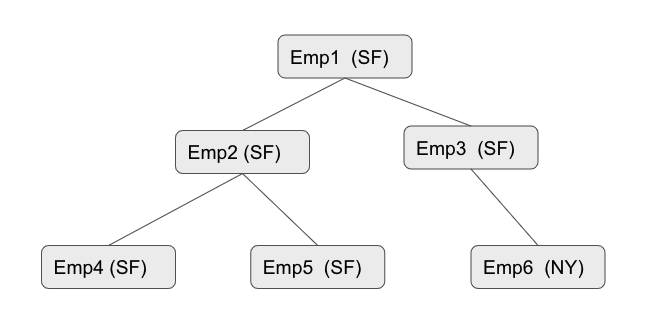
In the example above Only Emp 1 has his reportee chain in 2 different cities. (His own city does not matter, only reportee chain needs to have more than 1 city )
Solution for Part 2
List<String> result = new ArrayList<>();
	Map<String, String> phoneMap = new HashMap<>();
	Map<String, String> cityMap = new HashMap<>();
	Map<String, Set<String>> mgrEmps = new HashMap<>();

	public List<String> findPhone(String[][] input){

		String ceo = null;
		for(String[] emp : input) {
			phoneMap.put(emp[0], emp[3]);
			cityMap.put(emp[0], emp[2]);

			if(emp[0].equals(emp[1]))
				ceo = emp[0];
			else {
				mgrEmps.putIfAbsent(emp[0], new HashSet<>());
				mgrEmps.putIfAbsent(emp[1], new HashSet<>());
				mgrEmps.get(emp[1]).add(emp[0]);
			}
		}
		System.out.println(mgrEmps);
		getReporteeCities(ceo);
		return result;
	}

	public Set<String> getReporteeCities (String emp){
		Set<String> cities = new HashSet<>();
		for(String reportee : mgrEmps.get(emp)) {
			cities.addAll(getReporteeCities(reportee));
		}
		System.out.println(emp +"   "+cities);
		if(cities.size()>1)
			result.add(phoneMap.get(emp));
		cities.add(cityMap.get(emp));

		return cities;
	}
Comments (2)