


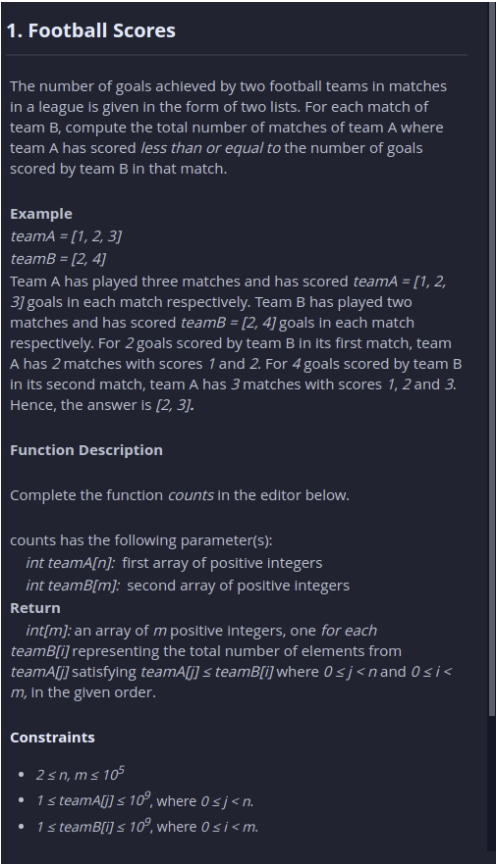
What would be the solution to this problem that is faster than O(N^2). Would it be possible to go faster than O(nlogn). My approach was to solve it by appending the arrays together and sorting them. Then I would have a dictionary for both teamA and teamB that would allow me to look up matches in each array in constant space. I would then increment my counter if it is part of teamA and append the count to my result array when it is part of teamB.
def foot(teamA, teamB):
    adic = Counter(teamA)
    bdic = Counter(teamB)

    res = []
    sortedteams = []
    for i in teamA:
        sortedteams.append(i)
    for j in teamB:
        if j not in adic:
            sortedteams.append(j)

    sortedteams.sort()
    count = 0

    for n in sortedteams:
        if n in adic:
            count += 1
        if n in bdic:
            res.append(count)

    return res

print(foot([2, 10, 5, 4, 8], [3, 1, 7, 8]))
Example solution
teamA = [2, 10, 5, 4, 8],
teamB = [3, 1, 7, 8]
output = [1, 0, 3, 4]Comments (9)