


I came across this question in the OA. The question was not that difficult but I messed up.
Here is the question.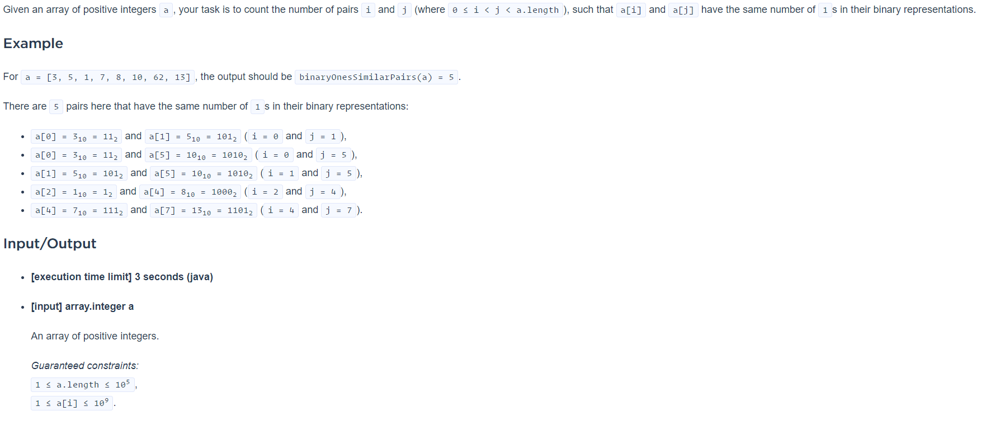
My approach was:
- Write a helper function to count the 1's in an int.
- Create another array with same length and add the count of 1's.
- Iterate through the array with countof 1's and form pairs.
I got 20/25 test cases passed. Here is my approach:
public static long pairBinary(int[] arr)
	{
		long count = 0;
		int[] binaryCountArray = new int[arr.length];
		for(int i=0;i<arr.length;i++)
		{
			binaryCountArray[i] = getNumberOfOnes(arr[i]);
		}
		for(int i=0;i<binaryCountArray.length;i++)
		{
			for(int j=i+1;j<binaryCountArray.length;j++)
			{
				if(binaryCountArray[i] == binaryCountArray[j])
				{
					count += 1;
				}
			}
		}
		return count;
	}

	public static int getNumberOfOnes(int n)
	{
		int count = 0;
		String binary = Integer.toBinaryString(n);
		for(int i=0;i<binary.length();i++)
		{
			if (binary.charAt(i) == '1')
			{
				count += 1;
			}
		}
		return count;
	}
It was due to timeout. What improvement should I have done?
I thought of using HashMaps but was running out of time so sumbitted the code.
Comments (9)