Problem Statement-1
A sequence is considered harmonious if it can be divided into a series of groups, and each group starts with a number that indicates the number of items in that group, followed by exactly that many items.
For example, the sequence [3, 7, 2, 6, 2, 4, 4] is harmonious because it can be divided into two groups: [3, 7, 2, 6] and [2, 4, 4]. The first group begins with the number 3, indicating 3 elements following it. The second group begins with the number 2, indicating 2 elements following it.
Similarly, the sequence [1, 8, 4, 5, 2, 6, 1] is harmonious, as it can be divided into groups [1, 8] and [4, 5, 2, 6, 1] that satisfy the criteria.
However, the sequence [3, 2, 1] is not harmonious.
An empty sequence is harmonious.
You are given a sequence of integers A of length N.
In one operation, you can remove any element from the sequence. What is the minimum number of operations required to make the sequence harmonious?
Input
The input to the solution function consists of:
- A single integer N (1 ≤ 𝑁 ≤ 200,000)the length of the sequence 𝐴.
- A sequence of 𝑁 integers A1,A2,A3...An (1 ≤ 𝐴𝑖 ≤ 100,000)the elements of the sequence 𝐴.
Output
Return the answer, which is the minimum number of operations required to make the sequence harmonious.
Examples
Input :
6
[3, 4, 1, 6, 7, 7]
output: 1
Explanation:
Removing the first element leads to a harmonious sequence [4, 1, 6, 7, 7] as the sequence begins with 4 and has 4 elements following it.
PROBLEM STATEMENT -2
You are given an array of intergers ,count the number of elements having atleast one smaller value and atleast one greater value.
Input :
The input to the solution function consists of an integer array Nums.
Ouput:
Return the count.
Example:
input
nums=[1,2,3]
ouput:1
Explanation:only elemet 2 satisfies the condition.
PROBLEM STATEMENT -3
Imagine you are an avid gardener planning the layout of a large garden. You have to generate a 2D grid where each cell represents a plot in the garden. You can either plant a flower in a plot or leave it empty. After planting, you want to analyze the garden to find unique arrangements of flowers that form an "L" shape, as these arrangements are aesthetically pleasing and optimize space usage.
A value of 1 in the grid indicates a plot where a flower is planted, and a value of 0 indicates an empty plot.
An "L" shaped flower arrangement is defined as follows:
A collection of 3 plots of a garden is said to be L shaped arrangement if one of its plots is in the same row with another plots and in the same column with the third plots. The 3 plots do not have to be next to each other.
All three plots must contain flowers (value of 1).
Input:
The inputs provided will include "row", "col", "magicNumber", and "mod". "Row" and "Col" specify the size of the grid in terms of rows and columns. To determine the presence of a flower in any cell, we use the formula:
((i+j+magicNumber)%mod)%2
where 'i' and 'j' refer to the row and column indices, respectively. The indices 'i' and 'j' start from 0 and go up to 'row-1' and 'col-1', respectively. The '%' symbol denotes the modulus operation.
Output
Return the number of such "L" shaped arrangements in the garden.
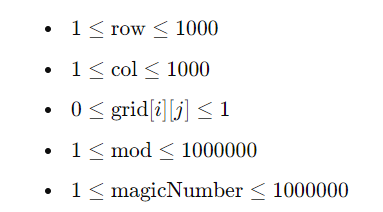
Constraints
Example:
Input:
row=3
col=3
mod=4
magical number=1
output: 4
according to the given values matrix formed will be :
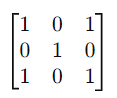
so possible ans :
- (0,0), (0,2), (1,1)
- (0,0), (1,1), (2,0)
- (0,2), (1,1), (2,2)
- (1,1), (2,0), (2,2)
anyone able to solve ques3?