
QUESTION:
OBSERVATIONS:
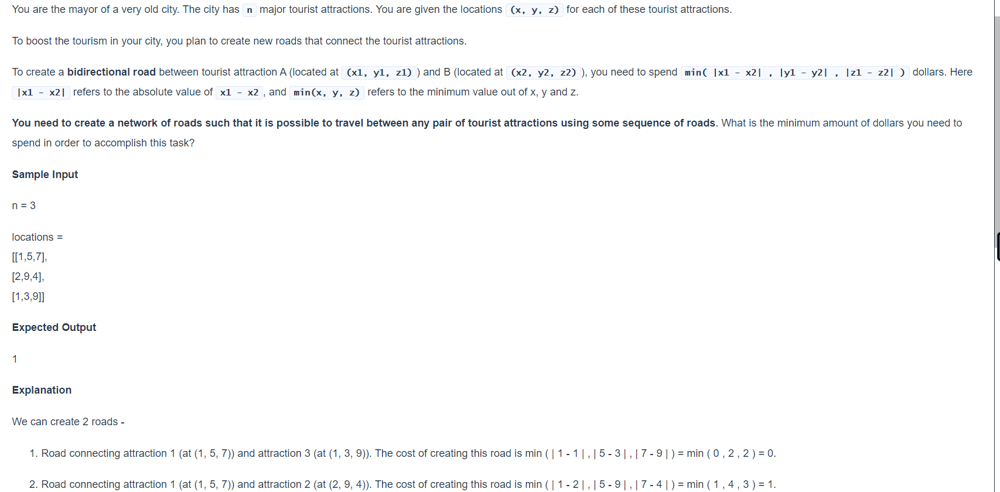
- Basically what is asked of us is to form a MST for the given graph and return total edge weight of that MST.
- MST algorithms like Prims or Kruskals take
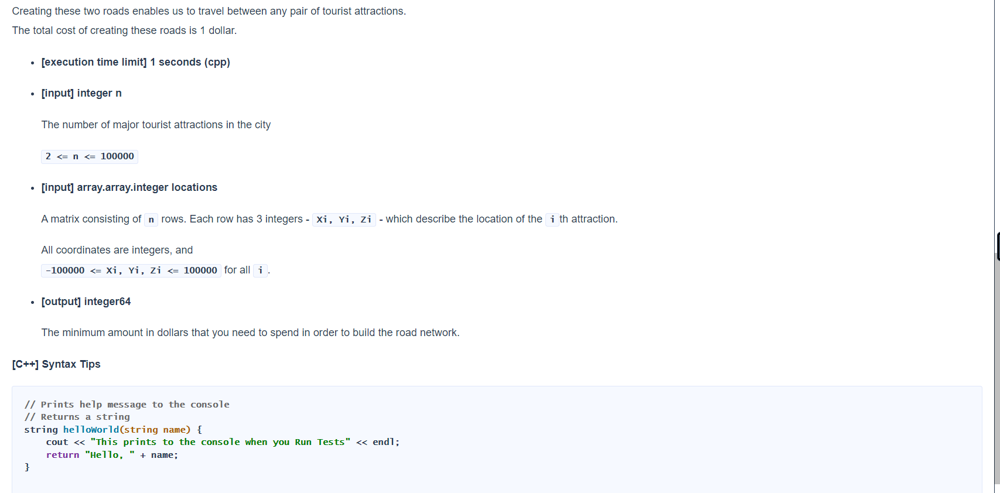
O((V+E)logV)andO(ElogE)respectively. V = NandE = N^2as it is a fully connected graph. Thus simple Prim's / Kruskal's wont work.- MST has V-1 total edges. That means of the N^2 edges in our graph, we will effectively only be using N-1 of those.
- Thus majority of edges are not of any use to us.
- We somehow need to reduce the number of edges to solve under given execution time.
- Thus Effective No. of Edges must be (Some Constant) X N.
- On a completely unrelated note: The minimum absolute difference of a given value X[i]=A at index i in a sorted array X is with either X[i-1] or X[i+1]. THIS IS IMPORTANT.
MY APPRAOCH:
- Sort the given
X, Y, Zedges intoX_sorted, Y_sorted, Z_sortedwith each element being[value, original_index]. - Now we iterate
ifrom0 -> n-1 - For
ithindex in X/Y/Z_sorted. The original node at i will have smallest x, y, z absolute difference with its ajdacent elements i.e with nodes ati-1andi+1. Hence we add edge b/w node at indexiand node at indexi-1andi+1 - The effective number of edges for current node becomes:
X_sorted[i][1] --- X_sorted[i-1][1]X_sorted[i][1] --- X_sorted[i+1][1]Y_sorted[i][1] --- Y_sorted[i-1][1]Y_sorted[i][1] --- Y_sorted[i+1][1]Z_sorted[i][1] --- Z_sorted[i-1][1]Z_sorted[i][1] --- Z_sorted[i+1][1]- Thus for each node we can have atmost 6 edges. Thereby the total effective number of edges become 6N.
- The above idea is difficult to grasp. What helped me was to rather than looking at the problem like a Graph problem, think of it as a Geometry Problem. You have multiple points on a 3D plane. And we want to connect them by using smallest amount of line segments. Since 3D is difficult to imagine, I took 3 different planes one for X, one for Y, one for Z.
- Simply apply Kruskal's Algorithm on the formed graph.
If your are thinking that the nodes closer to each other will form edges with one another. And hence we will have a disconnected graph??
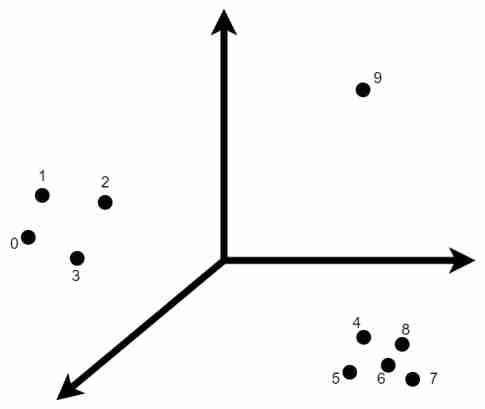
For nodes distribute like given below. We can see that there are 3 groups of points - Group1:{0,1,2,3}, Group2:{4,5,6,7,8}, Group3:{9}. Now when we sort them along x, y, z. These nodes as they appear here in groups wont appear in groups in the sorted arrays. Why?? Because group in 3D plane depends on all of x, y, z simultaneously but in X/Y/Z_sorted they won't as there they only depend on x/y/z. Hence in sorted array the nodes will get intermingled. No Grouping. Hence when we Binary Search for a certain node, we will get x_prev and x_after from different or same groups. Hence their wont be any problem of disconnected graphs.
CODE: (Code might look long, but the important bits are'nt. The implementation of Disjoint Sets and Graphs takes a lot of space.)
from random import randint
from heapq import *

# Disjoint Sets using UNION BY RANK and PATH COMPRESSION
class DisjointSets:
    def __init__(self, n):
        self.n = n
        self.parent = [i for i in range(n)]
        self.rank = [0] * n

    def find(self, x):
        if self.parent[x] == x:
            return x
        self.parent[x] = self.find(self.parent[x])
        return self.parent[x]

    def union(self, x, y):
        parent_x, parent_y = self.find(x), self.find(y)
        if parent_x == parent_y:
            return
        rank_x, rank_y = self.rank[x], self.rank[y]
        if rank_x < rank_y:
            self.parent[parent_x] = parent_y
        else:
            self.parent[parent_y] = parent_x
            if rank_x == rank_y:
                self.rank[parent_x] += 1

# Custom made graph class.
class Graph:
    def __init__(self, v):
        self.v = v
        self.edge_list = []

    def add_edge(self, source, target, weight=1):
        heappush(self.edge_list, [weight, source, target])

    def kruskals_algorithm(self):
        setMST = n = 0
        ds = DisjointSets(self.v)
        while self.edge_list:
            if n > self.v: break
            edge = heappop(self.edge_list)
            source, target = ds.find(edge[1]), ds.find(edge[2])
            if source == target: continue
            ds.union(source, target)
            setMST += edge[0]
            n += 1
        return setMST

######### BRUTE APPROACH:
def brute_solver_two(n, X, Y, Z):
    graph = Graph(n)
    for i in range(n):
        for j in range(n):
            graph.add_edge(i, j, min(abs(X[i]-X[j]), abs(Y[i]-Y[j]), abs(Z[i]-Z[j])))
    return graph.kruskals_algorithm()

######### OPTIMIZED APPROACH:
def optimized_solver_two(n, X, Y, Z):
    graph = Graph(n)
	# Sorted arrays with element being pair of [value, node_id]
    X_sorted = sorted([(x, i) for i, x in enumerate(X)])
    Y_sorted = sorted([(y, i) for i, y in enumerate(Y)])
    Z_sorted = sorted([(z, i) for i, z in enumerate(Z)])
    for i in range(n):
        if i > 0: # We can take edge b/w current node and node at i-1 index.
            graph.add_edge(X_sorted[i][1], X_sorted[i-1][1], abs(X_sorted[i][0] - X_sorted[i-1][0]))
            graph.add_edge(Y_sorted[i][1], Y_sorted[i-1][1], abs(Y_sorted[i][0] - Y_sorted[i-1][0]))
            graph.add_edge(Z_sorted[i][1], Z_sorted[i-1][1], abs(Z_sorted[i][0] - Z_sorted[i-1][0]))
        if i < n-1: # We can take edge b/w current node and node at i+1 index.
            graph.add_edge(X_sorted[i][1], X_sorted[i+1][1], abs(X_sorted[i][0] - X_sorted[i+1][0]))
            graph.add_edge(Y_sorted[i][1], Y_sorted[i+1][1], abs(Y_sorted[i][0] - Y_sorted[i+1][0]))
            graph.add_edge(Z_sorted[i][1], Z_sorted[i+1][1], abs(Z_sorted[i][0] - Z_sorted[i+1][0]))
    return graph.kruskals_algorithm()


# Testing optimized approach with respect to brute one.
# The brute one obviously works.
# The optimized one is to bew checked.

n = 6
X = [0,10,4,10000,10011,10027]
Y = [11,4,7,10009,10102,10061]
Z = [21,3,20,10019,10059,10011]
print("Brute:", brute_solver_two(n, X, Y, Z), end=" ")
print("Optimized:", optimized_solver_two(n, X, Y, Z))
print("Brute:", brute_solver_two(3, [1,5,7],[2,9,4],[1,3,9]), end=" ")
print("Optimized:", optimized_solver_two(3, [1,5,7],[2,9,4],[1,3,9]))
print("Brute:", brute_solver_two(3, [1,2,1],[2,9,4],[7,4,9]), end=" ")
print("Optimized:", optimized_solver_two(3, [1,2,1],[2,9,4],[7,4,9]))
n = 8
X = [1,11,3,2,1,7,4,7]
Y = [7,2,3,8,11,2,3,2]
Z = [2,3,1,4,10,8,9,8]
print("Brute:", brute_solver_two(n, X, Y, Z), end=" ")
print("Optimized:", optimized_solver_two(n, X, Y, Z))
n = 10
X = [15, 11, 17, 11, 8, 10, 16, 19, 17, 12]
Y = [15, 18, 18, 19, 14, 14, 15, 14, 16, 11]
Z = [6, 18, 18, 3, 16, 19, 15, 13, 16, 6]
print("Brute:", brute_solver_two(n, X, Y, Z), end=" ")
print("Optimized:", optimized_solver_two(n, X, Y, Z))
# Random Test Case Generator.
for t in range(5):
    n = randint(100,10000)
    X = [randint(-100000,100000) for _ in range(n)]
    Y = [randint(-100000,100000) for _ in range(n)]
    Z = [randint(-100000,100000) for _ in range(n)]
    print("Brute:", brute_solver_two(n, X, Y, Z), end=" ") # Wait for a while as brute method takes time for larger values of n.
    print("Optimized:", optimized_solver_two(n, X, Y, Z))