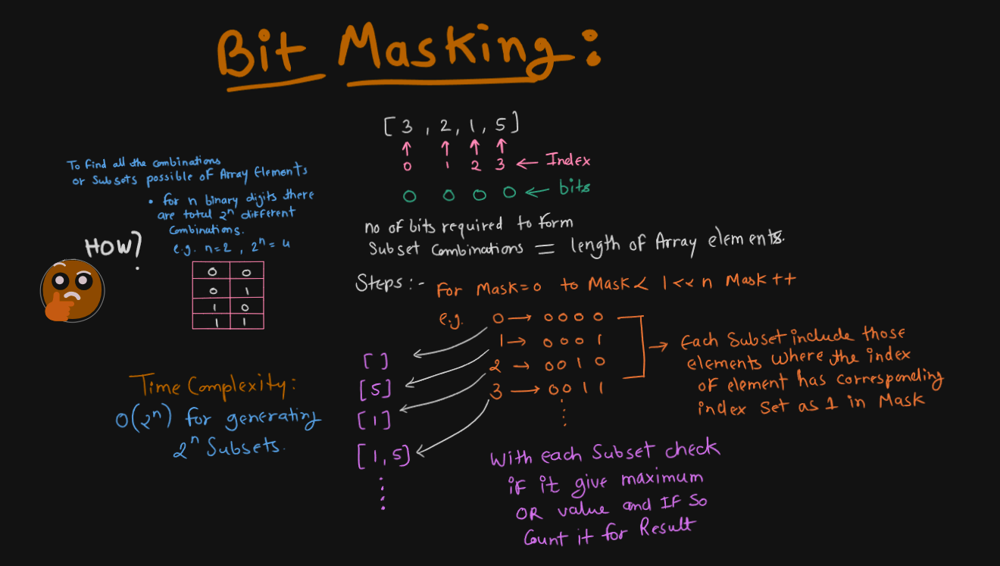
Simplified Explanation of Bit Masking for Subset Generation
Bit masking is a technique to generate all possible subsets of an array by using binary numbers. Each binary number (or mask) represents a different combination of elements in the array.
How It Works:
Array Example: [3, 2, 1, 5]
Binary Masks: For an array of size n, you need n bits in a binary number (one for each element).
For example, the mask 0001 means only the last element (5) is in the subset.
The mask 0011 means the last two elements (1 and 5) are in the subset.
Steps:
Each element in the array has a position (or index).
For each binary mask, if a bit is 1, the corresponding element is included in the subset. If it’s 0, the element is excluded.
All possible binary masks (from 0000 to 1111 for an array of size 4) represent all possible combinations or subsets.
Key Points:
The number of subsets is 2^n (where n is the length of the array).
Time Complexity: O(2^n), as there are 2^n subsets.
Example:
Mask 0011 includes elements at positions 3 and 4, creating the subset [1, 5].
By converting each number into a binary mask, this method efficiently checks all possible subsets of the array. It's commonly used in problems where you need to test various combinations of elements.