


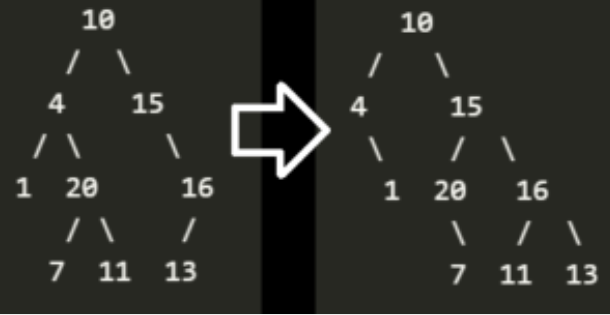
Shift all the nodes to the right if there is an empty place in a Binary tree. Every level should be filled from the rightmost side. See image for example:
C++ Implementation#include<bits/stdc++.h>
using namespace std;
struct Node
{
int data;
Node* left,*right;
Node(int k)
{
data=k;
left=right=NULL;
}
};
Node* solve(Node* root)
{
queue<Node*>q;
q.push(root);
while(!q.empty())
{
int sz=q.size();
queue<Node*>parent;
queue<Node*>child;
queue<Node*>del;
for(int i=0;i<sz;++i)
{
Node* curr=q.front();
q.pop();
parent.push(curr);
del.push(curr);
if(curr->right)
{
child.push(curr->right);
q.push(curr->right);
}
if(curr->left)
{
child.push(curr->left);
q.push(curr->left);
}
}
while(!del.empty())
{
Node* curr=del.front();
del.pop();
if(curr->left)
curr->left=NULL;
if(curr->right)
curr->right=NULL;
}
while(!parent.empty() && !child.empty())
{
Node* par=parent.front();
parent.pop();
Node* rigt=child.front();
child.pop();
par->right=rigt;
if(child.size()>0)
{
Node* lft=child.front();
child.pop();
par->left=lft;
}
}
}
return root;
}
void print(Node* root)
{
if(!root)
{
cout<<"NULL"<<" ";
return ;
}
print(root->right);
print(root->left);
cout<<root->data<<" ";
}
int main()
{
Node* root=new Node(10);
root->left=new Node(4);
root->right=new Node(15);
root->right->right=new Node(16);
root->right->right->left=new Node(13);
root->left->left=new Node(1);
root->left->right=new Node(20);
root->left->right->right=new Node(11);
root->left->right->left=new Node(7);
root=solve(root);
print(root);
return 0;
}Comments (1)