

Friends Pairing Problem

22501
Given n friends, each one can remain single or can be paired up with some other friend. Each friend can be paired only once. Find out the total number of ways in which friends can remain single or can be paired up.

Eg
Input  : n = 3
Output : 4
Explanation:
{1}, {2}, {3} : all single
{1}, {2, 3} : 2 and 3 paired but 1 is single.
{1, 2}, {3} : 1 and 2 are paired but 3 is single.
{1, 3}, {2} : 1 and 3 are paired but 2 is single.
Note that {1, 2} and {2, 1} are considered same.
Recursive Algo
f(n) = ways n people can remain single
       or pair up.

For n-th person there are two choices:
1) n-th person remains single, so only 1 way so  we recur
   for remaining i.e f(n - 1)   or you can say 1*f(n-1)
2) n-th person pairs up with any of the
   remaining n - 1 persons. So apart from the 2 people forming a pair for remaining n-2 persons we We get (n - 1) * f(n - 2) ways

Therefore we can recursively write f(n) as:
f(n) = f(n - 1) + (n - 1) * f(n - 2)
Recusrive Code:
 int countFriendsPairings(int n)
    {

        if(n<=2) return n;
        return countFriendsPairings(n-1)+ (n-1)*countFriendsPairings(n-2);
    }
It has overlapping suproblems Eg F(4) has :
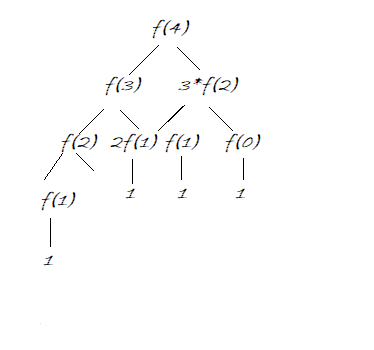
OR
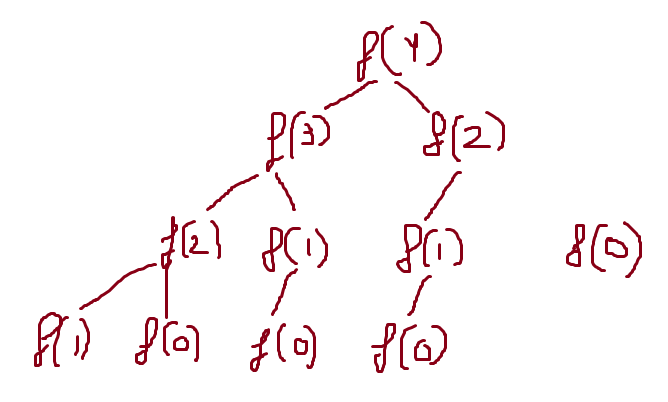
DP: (O(N) time and O(N) space
Memo
int solve(int n, vector < int > & dp) {

   if (n <= 2) return n;

   if (dp[n] != -1) return dp[n];

   return dp[n] = solve(n - 1, dp) + (n - 1) * solve(n - 2, dp);
 }

 int countFriendsPairings(int n) {

   vector < int > dp(n + 1, -1);
   dp[0] = dp[1] = 1;
   return solve(n, dp);
 }
Pure DP
 int countFriendsPairings(int n)
    {
        vector<int> dp(n+1,0);
        dp[0]=1;  // null subset
        dp[1]=1;  // 1 way possible

        for(int i=2;i<=n;i++)
        {
            dp[i]=(1*dp[i-1] + (i-1)*dp[i-2];
        }
        return dp[n];
}- Since it is similar to fibonacci we have another approach in O(1) space
Fibonacci Similar
    int countFriendsPairings(int n)
    {
        if(n<=2) return n;
        int a =1, b = 2, c = 2;
        for(int i=3;i<=n;i++){
            c = 1*b + (i-1)*(a);
            a = b;
            b = c;
        }
        return c;
}Comments (9)